



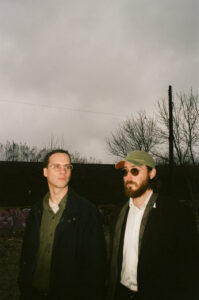
 Foto-© Alexa Viscius
Small Talk – das vierte und zweifellos eindringlichste Album des US-amerikanischen Duos Whitney – begann, noch bevor ihr drittes, Spark, überhaupt fertiggestellt war. Irgendwann im Sommer 2021 befanden sie sich in der Nähe von El Paso, in den letzten Tagen der Arbeit an dieser Platte gemeinsam mit Produzent Brad Cook. Während einer Studiopause fuhren die drei in die Vororte, rauchten Gras und spielten ein paar Runden Topgolf. Im Laufe der Jahre war Cook zu einem vertrauten Freund und Kollaborateur geworden. Auf der Rückfahrt, während die drei über den kreativen Prozess sprachen, stellte Cook das Radio aus und gab einen unerwarteten Rat: Whitney bräuchten ihn nicht mehr – oder überhaupt irgendeinen Produzenten. Whitney hätten die Vision und die Fähigkeiten, ihre eigenen Platten zu machen – tatsächlich, wie sich herausstellte, vielleicht sogar ihre bisher beste.
Nach einem Jahrzehnt als Mitbewohner und Bandkollegen – zunächst bei Smith Westerns und dann bei Whitney – gingen Julien Ehrlich und Max Kakacek also im Sommer 2024 ins Studio, um Small Talk ohne Produzenten aufzunehmen, wobei verschiedene Freunde vorbeikamen, um Parts beizusteuern. Das Ergebnis sind elf strahlende Songs, die auf zwei Ebenen begeistern: Zum einen finden sich hier klassische Whitney-Songs, die an denselben herzlichen Retro-Melodiesaiten zupfen wie immer, und zum anderen Momente, die zeigen, wie viel Raum sie sich für ihre Weiterentwicklung gelassen haben.
Wir sprachen mit der Band über ihr diese Woche erscheinendes neues Album via Zoom, erfuhren mehr über die neu gewonnenen Unabhängigkeiten, was Mark Wahlberg mit dem Album zu tun hat und vieles mehr zu Small Talk – unser Interview:
Can you tell me what inspired the sound and themes of the new album?
Julien: Ok yeah, so after making Spark and exploring and broadening the palette quite a bit, we always knew that we were going to incorporate a bit more of an organic texture type of thing. We knew we didn’t want to revert back to the tools that we were using on Light Upon the Lake, or Forever Turned Around, so we went into it with no, hard fast rule, for example no synths. We just wanted to do it as tastefully as we could.
Max: Yeah as far as themes go, we never really have any rules around it. Like we never say “this is what we will write our records about”, its more just the sentiment that the song is asking us to write about and sometimes that takes a long time and sometimes it reveals itself right away. This record was a mixture of both of those circumstances, or patterns.
How do you keep that creative process exciting after several album releases? How are you trying to challenge the sound that you’re creating?
Max: Well, I think going off what Jules just said, Spark was a little bit of a departure for us, so I think when we went to start writing and recording the first few demos of the new album, we were re-inspired by playing, or capturing organic instruments in a space again. In Spark we were really into working more electronically in a lot of ways and playing a lot with loops and kind of being constrained by those dynamics of what loop-making is like. So it actually felt good to play as a band again. So it was putting that sound down for a second and approaching it with fresh ears and not feeling like it was so repetitive to us.
Sure. And what track did you start with? Was it Back to the Wind?
Julien: Yeah, that’s the song that we fully went in and fleshed out. We made the record with Ziad and Rar mostly, and that was the song that we sat down and fully thought about. That was the one we fully nailed down. There are a couple of ideas that their origins maybe go back a little further than Back to the Wind, but yeah, I would consider Back to the Wind the first. That was at least when we knew this one is gonna be on the next album for sure.
How do you come to understand that a song is worth pursuing, or is the catalyst for a new album? Does it feel right, or are you playing it to certain people to gain validation. What’s the process here?
Julien: I think for that specific song [Back to the Wind], we just had such a productive two days in the studio… it was when we were auditioning the studio in Oregon, that we ended up working there a little more and it was peak Springtime in Oregon, so pretty idyllic in the natural world. We spent two days in the studio, kind of hunkered down making it, and then spent a day driving, listening to it, and were like, damn, this is just…it kind of looked as beautiful as everything was around us and I think that kind of made us confident in our ability to make stuff on our own that stood up to the “driving test”…which is a huge test, I think, for all music makers.
Definitely, definitely, it sure brings that. How would you describe this album differing from perhaps your previous albums?
Max: To me, I feel as though you can hear our age in a good way. And I don’t want the answer to your question to just be, like, “oh we got older, that’s what makes it different” but, it does just feel like there’s a depth in the lyrics and the arrangements and compositions and some of the song structures, and I just don’t think we would have really known how to pull that off at any younger age. There are certain songs where I am like I wish we had written Back to the Winds earlier in our careers, because its poppy, catchy and really pleasing, but it’s funny as I’ll have that thought and then think there’s no way that would have ever happened. I think that’s what makes this album feel different or unique to me.
Was there a particular song that was difficult to finish, or took a completely different direction than you originally planned?
Julien: Yeah there’s a couple, with Dandelions we wrote maybe 3 different choruses that became different songs. I’m not sure if The Thread came out of one of them, but something else did. I can’t remember which it was…
Max: The verse of Dandelions came out of a song which was the verse that we tried to write for New Year’s, a song that isn’t even on the record. Then with Darling, that idea sort of stemmed back from Spark era. We tried to write like a c-section to that song for a solid few weeks straight. And then it wasn’t until partway through writing Small Talk that we thought why did this ever need a c-section? All we needed to do was basically finish writing the lyrics to it. One of the c-sections that we tried to write became the outro, because we were like this part is so good and it does feel intrinsically linked to ‘Darling’ as a song. We sort of just finished the arrangement to it and we were like well it feels perfect with the lyrics and everything.
Jules: Actually yeah, we never really talk about this, but yeah an interesting part is that we’ll think of parts having their own identity. So, if we’re in a really hard writing spot and we have the verses that we like, but no chorus is working out, we’ll make a new song with the chorus as the verse of the song and try to reuse. So we’re always taking parts out of songs and trying to put them into other ideas.
 You have the co-track Evangeline with Madison Cunningham, what’s it like bringing this sort of richer textured voice to the track. How was it co-creating with her? Did it shift the original vision for the song?
Max: Honesty, it was really nerve-wracking. I mean a lot of people insist on doing stuff remotely, but she insisted on getting us all in the studio because she wanted to nail the vocal takes. That freaked me out as we all really love Madison’s voice, but we had never really done an original duet with anybody. I was thinking what if the blend of voices doesn’t really work together? It’s an artist that we respect so much, it would have been a nightmare to have to say “sorry we’re not gonna use it”. That obviously didn’t happen as she nailed the vocal take. It’s a song I’ve come back to and listened to, and it feels like a real highlight, not only on the record, but, in our whole discography. Yeah, she nailed it.
I’m interested to hear about the different sounds and arrangements on the album. I’m curious to hear how you incorporate all of these different sounds for example orchestral tones, pop, folk. How do you kind of make space for all of those sort of sounds and voices, without losing, coherence? How do you bring it all together so that it’s your sound and its not deviating away from the sound of Whitney?
Jules: I think when we’re usually most successful at that, its not something we’re whittling away at very much, it just comes naturally. For example on Islands, this song is a great example of that. The second we started recording that, it just felt as though it was completed after the first session. And some songs work in that way, but with this record, we worked subtractively far more than we normally would have. We built up songs to the point where they’re too maximalist, then in the mixing process, we’d whittle them down to become more concise and direct. One thing we can do as producers and arranges is really overdo the use of melody within the arrangement process. So I think the fun part of making this record was, when we stripped back some of the arrangements from what they are now, which is pretty dense, the songs opened up a lot. I don’t think we’ve worked that way in a while where it was kind of a case of add too much information and find out what is essential.
What are your favourite tracks on the album?
Max: The song Islands – I think it feels really special to both of us. I don’t really know why, but the lyrics do feel really pretty poignant and also the blend of textures on the recording. It was the first song that we got the final mix on, and it just really fitted into place immediately, which is pretty unique for us. The electronic-sound solo that comes in is a moment that I think is another choice that we probably wouldn’t have been able to create at an earlier point in our careers. It just feels really impactful, it’s the record at the moment that gives me chills.
What would you listen to on repeat?
Max: Oh its dependent on what happened that week, but I think Small Talk for me, because it has a bit more of a challenging chord progression, than something like The Saddle or something.
If you could describe the albums that you have curated as a weather system, can you tell me how it might shift from album to album?
Max: That’s a good question. I think seasoned in places makes more sense to me. I think ‘Light Upon the Lake’ is probably a springtime Midwestern, like newfound life or something.
Jules: Yeah, I was gonna say Light Upon the Lake and Forever Turned Around are spring and fall, but I think Forever Turned Around is maybe actually winter. When we were recording, we were in a basement in the middle of winter putting beers outside to get cold, like leaving a 12-pack in the snow. Spark is when we took a break in Miami in summer and they didn’t bring anything of our gear with us. We bought a bunch of gear at a pawn shop and we kind of just got lost in with the locals. Then this record is definitely fall.
Max: Have you ever seen the movie Rockstar with Mark Wahlberg? So its like that, we went to Miami, that was his rock star moment and then when we went back to Chicago and got the out guitars again and that was like the end of the movie, when he went to Seattle.
Whitney Tour:
11.02.25 München, Hansa 39
12.02.26 Berlin, Lido
15.02.26 Hamburg, Knust
19.02.26 Köln, Gebäude 9

